How Hong Kong's abandoned buildings get a new lease of life as cultural centres
It tin can sometimes experience every bit if Hong Kong history is at risk of slipping away, in this fast-paced metropolis where heritage buildings are razed to brand room for skyscrapers and where traditional stage performers struggle to compete with popular culture.
But in the past year, several major venues have opened to bring new life to Hong Kong's British-Chinese by. Abased old buildings are being reopened as cultural centres. Fifty-fifty the city's fanciest new performance hall has been dedicated to the preservation of an aboriginal art class.
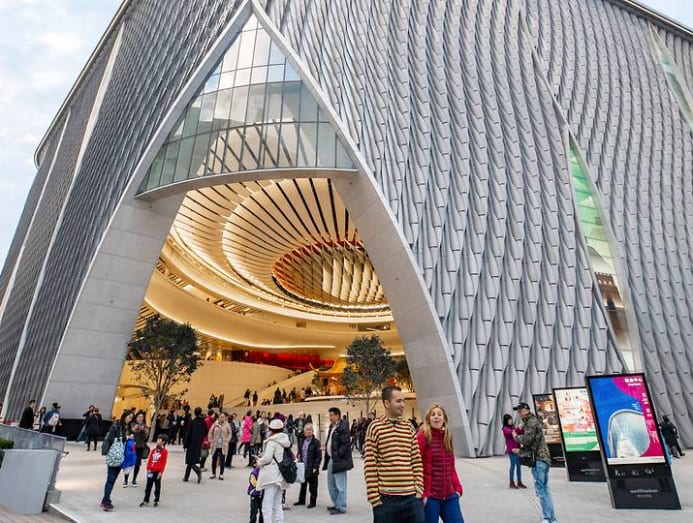
Architecture aficionados can pay homage to Bing Thom at the Xiqu Heart, a Cantonese opera house that opened in January. Information technology is the terminal cracking work by Thom, the Chinese-Canadian builder who died in 2022 before seeing the completion of his "homecoming" projection in the city of his birth.
Its exterior is crafted from waves of curled aluminium pieces, shimmering like thousands of silverish fish scales. The eight-storey building is shaped like stage curtains parting before the opening of a show. Natural calorie-free floods into the atrium through these "parts," making the opera firm feel similar a true public space. On a recent afternoon, a street artist set up upwardly an easel and children played in the opera house'south replica ancient Chinese wooden edifice.
An exhibition (through Jun 30) by Hong Kong photographer Ducky Tse documents the eight-year process of building the middle.
The history, culture and practices of Chinese opera are well explained in English-language tours, led by guides who keep their charges in line by banging on mini gongs.
Full classical productions are staged at the formal Grand Theatre, while the more causal Tea House Theatre offers shorter performances and dim sum snacks.
While y'all're there
The Xiqu Heart is part of the massive and nonetheless incomplete West Kowloon Cultural District. A short taxi ride abroad is the M+ Pavilion, an art space meant to complement the larger M+ museum, which is scheduled to open in 2020. Right outside is a waterfront promenade with sweeping views of Victoria Harbour and Hong Kong Island.
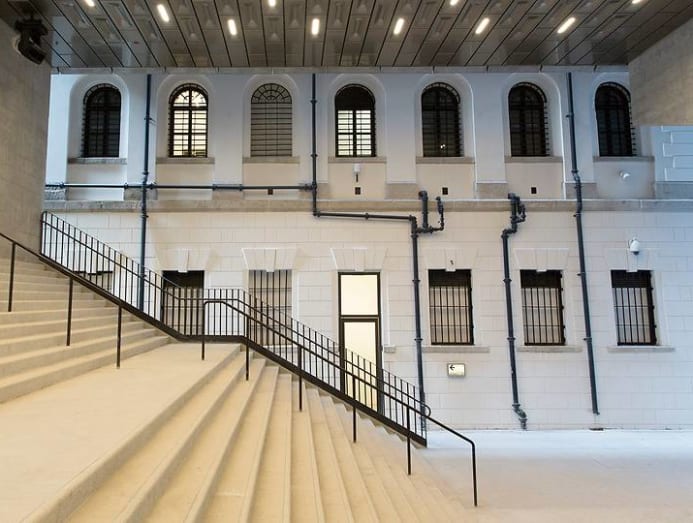
Tai Kwun, significant Large Station, was a 19th-century British-era police station, courtroom and prison. It reopened in 2022 every bit the Eye for Heritage and Arts, equally part of the city's almost ambitious restoration project. Historic buildings, gear up around vast courtyards, are now abode to exhibition spaces, studios, shops and restaurants.
A 45-minute, English-language heritage tour is available, just not strictly necessary. Tai Kwun is decidedly tourist-friendly; in its first half-year, it recorded one million visitors.
Though lavishly outfitted and promoted every bit a major tourist draw, Tai Kwun also functions as a serious art space. It has not been immune to debates nigh free expression in Hong Kong's tense political climate. In November, Tai Kwun cancelled an appearance by Chinese dissident writer Ma Jian, simply then quickly changed grade after coming nether criticism, allowing Ma the chance to speak in the end.
JC Contemporary, a nonprofit fine art space, offers two difficult-hitting shows this spring: The R-rated Performing Social club: The Violence of Gender (until Apr 28) and Contagious Cities: Far Away, Too Shut (until Apr 21), which documents disease in Hong Kong, from the 19th-century plague to modernistic-historic period epidemics like SARS, or severe acute respiratory syndrome.
While yous're there
Too while you're there
From Tai Kwun, take a five-infinitesimal walk downward Hollywood Road, through the heart of the artsy SoHo commune. This volition have you to PMQ, a old colonial-era Police Married Quarters. PMQ now comprises a whole urban center block housing minor enterprises, from vegetarian bakeries to fashion ateliers.
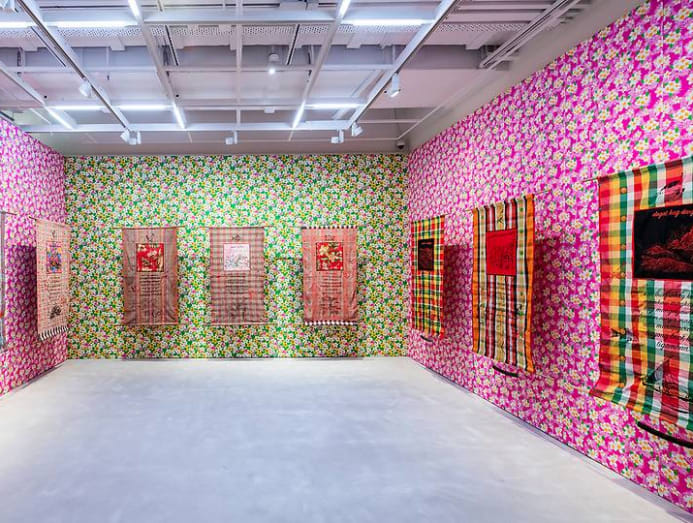
The neighbourhood of Tsuen Wan is at the end of the tracks, at the concluding station of i of Hong Kong's main MTR (subway) lines. An one-time cotton wool mill there, one time an integral part of Hong Kong'southward material manufacture and postwar development, has been transformed into a Centre for Heritage, Arts & Textile, or Conversation.
Its inaugural special exhibition, Unfolding: Fabric of Our Life, opened this month with works and performances by 17 artists and collectives using textiles "as a testimony of faded facts in modern history."
While y'all're at that place
New restaurants worth trying include the farm-to-tabular array Bee b. Farm, the locally run Koko Coffee Roasters and Honbo, a play on the Cantonese discussion for hamburger.
By Joyce Lau © 2022 The New York Times
READ> The Hong Kong chef discovering his heritage by "French-ifying" Chinese food
Source: https://cnalifestyle.channelnewsasia.com/experiences/hong-kong-xiqu-centre-tai-kwun-centre-for-heritage-arts-textile-239231
0 Response to "How Hong Kong's abandoned buildings get a new lease of life as cultural centres"
Enviar um comentário