Ou Know Who It Is
Who's is a contraction linking the words who is or who has, and whose is the possessive class of who. They may sound the same, but spelling them correctly tin be tricky. To become into the difference between who's and whose, read on.
Who's vs. Whose
- Both who's and whose come from the pronoun who (shocking, right?).
- Who's is a wrinkle, pregnant it'south two words stuck together. The formula: who + is, or who + has.
- For case: who'southward hungry?
- Whose is a possessive pronoun. Use information technology when you're request (or telling) to whom something belongs.
- For instance: whose sandwich is this?
Here's a tip: Want to brand sure your writing always looks swell? Grammarly tin can relieve yous from misspellings, grammatical and punctuation mistakes, and other writing problems on all your favorite websites.
But, when you need "whom" to explain what "whose" means, more information is needed. Plus, even though who's is a contraction and whose is possessive, put them together and you sound like an owl starting to fall comatose. That's considering these 2 words are homophones, meaning they sound the aforementioned, only mean different things. Keep your apostrophes where they belong by continuing through this explanation of who's vs. whose.
What Is Who?
Commencement up, let'south innovate this exceptionally catchy pronoun. Information technology has many forms, and many a dauntless soul has cowered in the attempt to use information technology correctly.
Who
Who is a discipline pronoun, like he, she, I, or they, simply information technology's the interrogative used for animate subjects. In other words, use it to inquire a question about which person did something or is someone.
"Who is in charge here?" "Who asked you to go to the trip the light fantastic?" "Who is that?"
Whom
This is the bane of many an English language-speaker's being. But it'due south not equally hard as you think: whom is an object pronoun, meaning if you could replace information technology with "him," "her," "me," or "them," yous're adept to go.
"Whom are y'all referencing?" "Whom did you ask to go to the dance?" "To whom are you speaking?"
Yeah, we know—it sounds stuffy. But if you lot want to exist correct correct, that's how it works.
And at present, on to the spelling culprits. 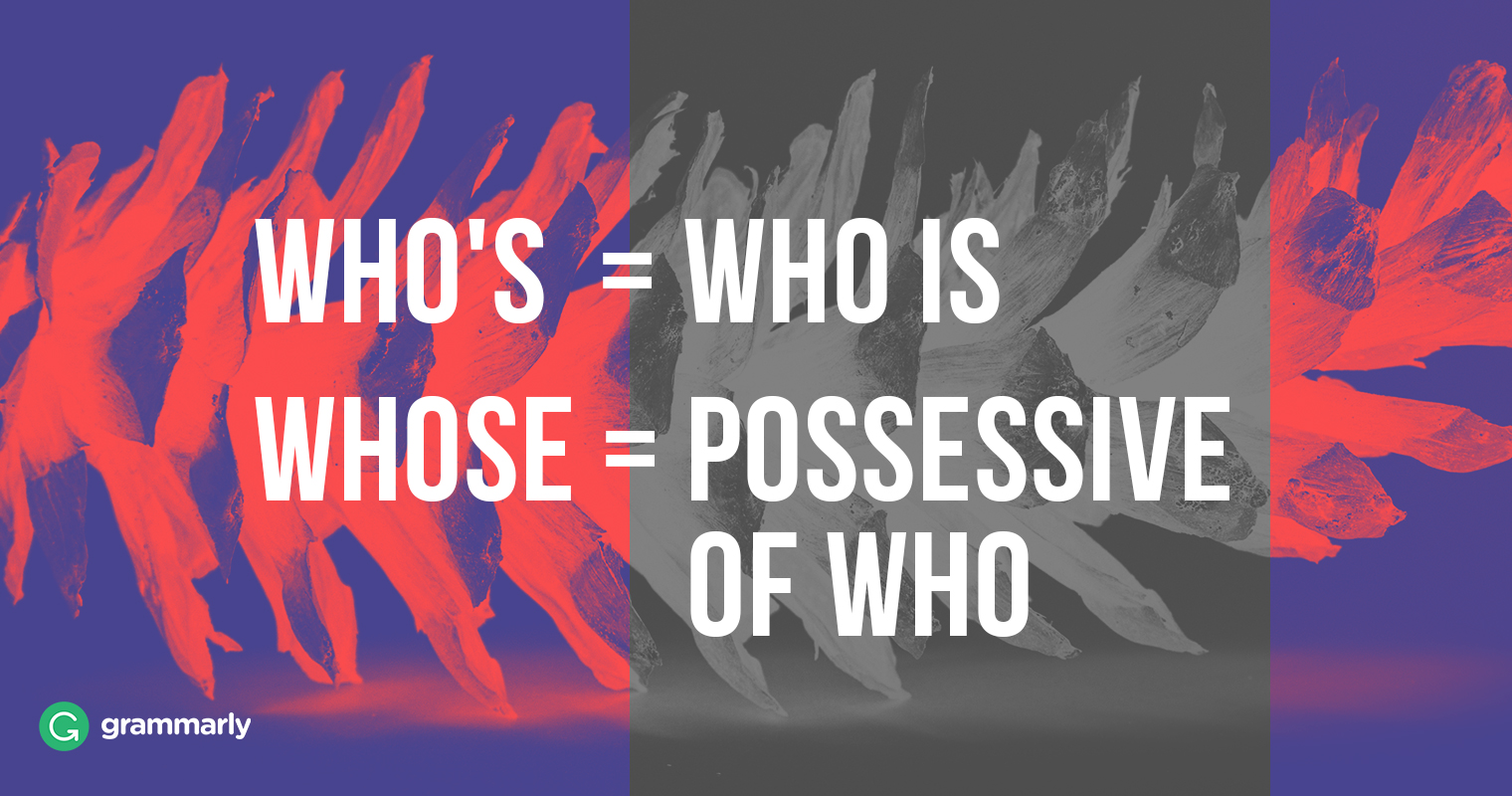
Who'south or Whose
They audio the same: hoos. Information technology rhymes with shoes.
So: is it who'due south shoes? Or whose shoes?
Who's
To recap, "who" is the pronoun used to mean "what or which person or people." Add together the apostrophe and the southward for these reasons:
Who's = who + is or
Who's = who + has
Really. It'southward that elementary.
Who's is a contraction. That means the apostrophe stands in for a letter that goes missing to make pronunciation easier and quicker. Imagine maxim "I do not know who is going to get." Out loud, it'll probably sound more than similar "I don't know who's gonna get." The jury's still out on gonna, but we'd guess y'all've already heard of using an apostrophe to marker an omitted word or sound. Wouldn't y'all agree?
Whose
Whose shoes? Translation: to whom do the shoes vest?
Whose is a pronoun used in questions to enquire who owns something or has something. In other words, whose is most possession.
Don't exist tricked: on the one hand, because grammazons marker possessive nouns with apostrophe + south, it'due south tempting to recollect that who's (not whose) is the possessive form of who. But apostrophes are also used in contractions. That's what the apostrophe indicates in who's, and that's why whose is the possessive form of the pronoun .
Recollect of information technology this way:
Its = belonging to information technology It'southward = contraction of information technology is or it has Whose = belonging to whom Who's = contraction of who is or who has
Incidentally, Who'south shoes? would hateful "Who is Shoes?" Some folks have strange nicknames. Like Blue. Whose clues? Blue's clues.
Weirdly, the higher up sentence wouldn't hateful "Who has shoes?"—y'all'd probably say "Who'due south got shoes?" if that's the meaning you're later on.
Who's Got Time for Examples?
Well, we hope yous practice. Only whose fourth dimension is it? Your time. We hope you'll spend it looking at these examples of how to use who's and whose.
Who'due south afraid of the large bad wolf?
If you have that tune stuck in your caput the rest of the 24-hour interval, yous can blame us.
Whose Line Is Information technology Anyway?
Who's against spicing up a grammar lesson with some '90s one-act?
The People Backside the Tusks: A Who's Who of the Cast of Warcraft
(moviepilot.com)
Consequently, their roles had to be filled past CIA officers whose identities had non been revealed to the Russians.
(Tom Clancy, Commander in Chief, 124)
Bessie carried a lantern, whose light glanced on moisture steps and gravel road sodden by a recent thaw.
(Charlotte Brontë, Jane Eyre, 50)
This one'south worth an extra glance: "who" in all its forms generally refers to animate beings, merely in the possessive there'southward no equivalent for inanimate objects like Bessie's lantern. The very awkward alternative is "Bessie carried a lantern, the light of which glanced on wet steps." Not expert.
And finally, a who've for good measure:
[They're] Kids from wealthier districts, where winning is a huge award, who've been trained their whole lives for this.
(Suzanne Collins, The Hunger Games, 36)
Yes, that means who have.
Who'due south Clear on Who's and Whose?
By now, anyone who has read this far, we hope. But in case, let's review:
-
- Both of these words are versions of the interrogative pronoun who.
- Who's is a contraction of who + is or who + has.
- Whose means "belonging to whom," and occasionally "of which."
Whose grammar got a boost from this read? Now you lot're someone who's ready to use these pronouns in style. 
Source: https://www.grammarly.com/blog/whos-whose/
0 Response to "Ou Know Who It Is"
Enviar um comentário