CHOP develops tool that uses weather to predict Covid-19 outbreaks
CHOP and the Virus
The hospital's PolicyLab has fabricated news with its innovative tool to track Covid-nineteen outbreak
Jun. 11, 2020


Last month, just before Memorial Mean solar day, headlines blared of a new study warning of a 2nd coronavirus wave, particularly throughout the Due south, as the rush to reopen local economies took off.
There, on CNN and in the pages of The Washington Mail service, was Dr. David Rubin, director of PolicyLab at Children's Hospital of Philadelphia, which had developed the model.
"As communities reopen, we're starting to detect evidence of resurgence in cases in places that have overreached a bit," he told the Postal service.
 What he didn't say was that CHOP'southward model was unique among all the other ones media outlets had been referencing in the bulldoze to predict the hereafter of the pandemic. The CHOP model, you lot see, uses the weather to predict the future.
Think of it this way. Taking your temperature is an like shooting fish in a barrel way to check whether you might exist experiencing i of the symptoms of Covid-19. A reading comfortably below 100 degrees indicates you don't have a fever. It doesn't guarantee that you haven't been infected with the coronavirus, only it tin offer some peace of mind.
Similarly, researchers studying the spread of the virus at a macro level are using the temperature outdoors, forth with humidity levels, and other geographic-specific data sets to forecast the probable prevalence of infections in particular areas.
"If we are fortunate to see that widespread manual has not followed [protests], information technology will add additional bear witness that the run a risk for SARS-CoV-ii spread outdoors nether conditions of increased heat and humidity remains minor," the CHOP squad said recently. "If not, we may need to recalibrate our response."
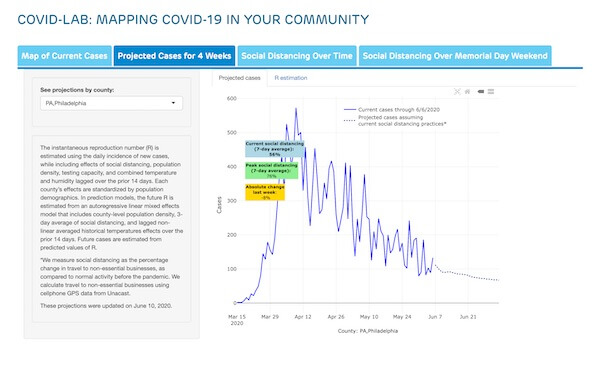
Using celebrated weather condition data, PolicyLab has adult a tool that researchers claim has fairly accurately tracked incidences of Covid-19 cases. The tool also takes into account a canton'south demographics, population density, and real-fourth dimension information on the amount of social-distancing adept there—using GPS cell phone data.
"There'due south a complex relationship betwixt temperature and the transmission of the affliction," says Dr. Gregory Tasian, a professor of urology and epidemiology at the Academy of Pennsylvania Perelman School of Medicine who is working on the forecasting model. "It's a very non-linear human relationship."
Tasian has a background in studying temperature's touch on on health, and in discussions with Rubin and Jing Huang, a professor of biostatistics at Penn, that began in late March, they decided to build a model looking at how weather and other variables would dictate rates of transmission.
"We were brought together by a shared commitment to modify the course of the Covid-19 pandemic and salve lives by informing decision-making," says Tasian.
In that location has been a bumper crop of epidemiological tools aiming to predict how the pandemic that has already killed more than than 100,000 Americans volition progress. In Philadelphia, a grouping of researchers from Penn Medicine teamed upwards with local volunteer programmers to develop a tool that allows people from any geographic region to plug in their own data and get a sense of how many Covid hospitalizations to expect.
The CHOP tool stands out in a couple of ways.
Tasian said he is unaware of any other models that incorporate temperature and humidity data. Besides, rather than producing estimates for unabridged states—the way the popular University of Washington model does—CHOP focuses on 389 counties with some level of disease outbreak.
In seasonal leap weather, transmission of the virus appears to diminish—which tracks with the way other coronaviruses and influenza viruses bear, according to Tasian. Just equally the mercury climbs higher, the virus begins to spread more than rapidly over again, he says.
That boomerang effect might be considering droplets containing the virus land on surfaces and stay at that place more readily in warmer weather, or because nice weather prompts people to get out of the house and socialize more—or both.
A pre-print of a CHOP study using the information from the model indicates that the virus spreads virtually quickly in the coldest temperatures, and slows downwards equally temperatures warm. At around 55 degrees, manual begins to increase once more, before dropping downwardly once more when the weather gets hotter.
Hot temperature alone cannot eradicate the virus, and even under the blazing Texas sun the cities of Dallas and Houston have recently shown signs of an expanding outbreak. The CHOP researchers propose that might be because of less social-distancing and less adherence to mask-wearing.
Merely the weather's effect on the pandemic could exist one reason why even subsequently Florida loosened restrictions on economic activity, the Sunshine State has not experienced the major fasten in coronavirus infections that many feared might occur. (In June, Florida reopened bars and movie theaters throughout much of the state, and officials there blamed a recent surge in Covid cases on all the socializing that took place during Memorial Day weekend.)
"I think weather could be a cistron that could account for some of these differences that we're seeing between Florida and other areas where it's however a bit cooler," says Tasian.
At that place are other factors that bear on the spread of coronavirus, and several have been incorporated into CHOP's model, including population density, the amount of social-distancing—and the health and well-being demographics of the population: the proportion of people over the historic period of 65, the proportion with diabetes, and the proportion living in poverty or just above poverty.
Measuring social-distancing
Perhaps the most high-tech aspect of the model is the manner CHOP measures social-distancing. For that, it turns to Unacast, a corporate intelligence firm founded by two of the people who built the music streaming service Tidal.
Unacast uses GPS information to note the travel patterns of people all over, and collates that data into social-distancing scorecards. The CHOP project looks at one metric—the change in visits to not-essential locations.
By that measure, Philadelphia has scored well since the lockdowns went into event in March with ane notable exception: Friday, May 29, when visits to non-essential locations were still below normal merely non as far downwardly as they had been.
That was the day earlier the first big protestation in Center Metropolis against systemic racism and police force brutality post-obit the police killing of George Floyd in Minneapolis.
"As communities reopen, we're starting to detect evidence of resurgence in cases in places that have overreached a scrap," Rubin told the Post.
As big protests accept become regular occurrences in American cities, forth with crackdowns by police force and demonstrators hauled off to jail, those events present a claiming for the CHOP squad.
Tasian said the Unacast data does non mensurate the number of people gathering in a public place, but the forecasts would pick upwards any hypothetical spike in cases from those gatherings.
In that location is a normal lag of well-nigh 2 to three weeks before data showing a spike in community spread would become apparent, according to the CHOP squad. That ways that past around June 13 or June xx, Philadelphia should have an idea about whether the protests significantly worsened the outbreak.
"If we are fortunate to see that widespread manual has not followed, it will add additional testify that the adventure for SARS-CoV-2 spread outdoors nether atmospheric condition of increased heat and humidity remains small and make usa more confident that we might find some respite this summer from the crisis we witnessed this leap," the CHOP team wrote in a recent weblog post. "If not, we may need to recalibrate our response."
"Much of the science is yet unsettled"
Scientists around the globe have scrambled to empathise the tiny virus that has killed roughly 400,000 people around the world, and more than 100,000 Americans. Because it is developing so quickly, much of the scientific discipline is still unsettled.
The safety and efficacy of hydroxychloroquine has been one of the most controversial areas of study, because President Trump embraced it as a miracle cure, even though there was practically no ground for that.
In May, a written report claimed that hydroxychloroquine did the reverse—increasing the run a risk of death and center bug amid Covid-19 patients—only then about a week later authors of that study conceded they could "no longer vouch for the veracity of the chief data sources," and it was retracted.
That high-profile reversal is non representative of the expert piece of work underway in labs across the earth, but it should be a reminder to maintain good for you skepticism about the latest scientific findings.
 The predictions made by models are easy to judge considering after enough fourth dimension is passed, the public can check in and see how accurate they proved to exist. Looking at Philadelphia, the CHOP model equally of early June predicted a deadening tapering off of new Covid-19 cases, dropping to 105 on June 30.
The researchers have been fine-tuning the CHOP model every 2 weeks, but Tasian said there has not been a need for whatever full-scale revisions in what the team uses to form the predictions.
In the time to come, depending on how the science progresses, the team might consider incorporating that amount of sunlight into the model along with information about the number of people who take antibodies—pregnant those who have fought off the disease and may retain some immunity to it.
The Pennsylvania Department of Health is looking at the CHOP model equally state leaders make decisions well-nigh how and when to reopen sectors of the economy beyond the state. Rubin has briefed officials across the country on the model, and worked with the Country Section and other pieces of the federal government.
Depending on how widely information technology is used, the CHOP model could have a real bearing on how restrictions are loosened in various parts of the country.
Photo courtesy quapan / Flickr 
Source: https://thephiladelphiacitizen.org/chop-policylab-tool-covid-19/
0 Response to "CHOP develops tool that uses weather to predict Covid-19 outbreaks"
Enviar um comentário